
Only recently described by science, mysterious mushrooms are found in different parts of the world, but they give people the same exact visions.
Every year, doctors at a hospital in the Yunnan Province of China brace themselves for an influx of people with an unusual complaint. The patients come with a strikingly odd symptom: visions of pint-sized, elf-like figures – marching under doors, crawling up walls and clinging to furniture.
The hospital treats hundreds of these cases every year. All share a common culprit: Lanmaoa asiatica, a type of mushroom that forms symbiotic relationships with pine trees in nearby forests and is a locally popular food, known for its savory, umami-packed flavor. In Yunnan, L. asiatica is sold in markets, it appears on restaurant menus and is served at home during peak mushroom season between June and August.
One must be careful to cook it thoroughly, though, otherwise the hallucinations will set in.
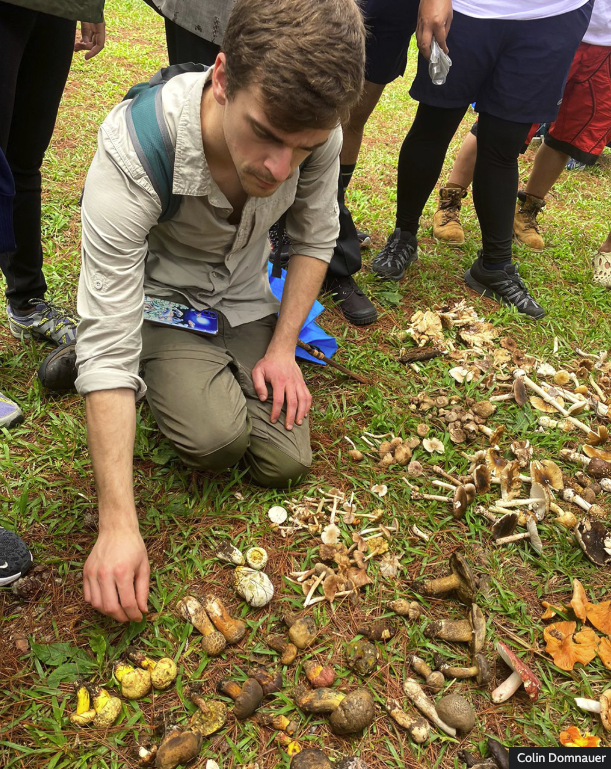
“At a mushroom hot pot restaurant there, the server set a timer for 15 minutes and warned us, ‘Don’t eat it until the timer goes off or you might see little people,'” says Colin Domnauer, a doctoral candidate in biology at the University of Utah and the Natural History Museum of Utah, who is studying L. asiatica. “It seems like very common knowledge in the culture there.”
But outside of Yunnan and a couple of other places, the strange mushroom is largely an enigma.
“There were many accounts about the existence of this psychedelic [mushroom], and many people who looked for it, but they never found the species,” says Giuliana Furci, a mycologist and the founder and executive director of the Fungi Foundation, a non-profit group dedicated to discovering, documenting and conserving fungi.
Domnauer is on a quest to solve the decades-old mysteries about this fungi species and identify the unknown compound responsible for its unusually similar hallucinations – as well as what it can potentially teach us about the human brain.
Domnauer first heard of L. asiatica as an undergraduate from his mycology professor.
"It sounded so bizarre that there could be a mushroom out there causing fairytale-like visions reported across cultures and time," Domnauer says. "I was perplexed and driven by curiosity to find out more."
“It sounded so bizarre that there could be a mushroom out there causing fairytale-like visions reported across cultures and time,” Domnauer says. “I was perplexed and driven by curiosity to find out more.”
The academic literature provided a few breadcrumbs. In a 1991 paper, two researchers from the Chinese Academy of Sciences described cases of people in Yunnan Province who had eaten a certain mushroom and experienced "lilliputian hallucinations"–the psychiatric term for the perception of tiny human, animal or fantasy figures. It is so named after the small people who inhabit the fictional Lilliput Island in the novel Gulliver's Travels.
The patients saw these figures "moving about everywhere," the researchers wrote–usually, there were more than ten tiny beings on the scene. "They saw them on their clothes when they were dressing and saw them on their dishes when eating," the researchers added. The visions "were even more vivid when their eyes were closed."
Read the full story by Rachel Nuwer at the BBC here.