Wildfires have been the story of Utah's summer where, as of August 10, a record 514,000 acres have burned. Of that figure, 290,000 acres of woodland forest alone have succumbed—a figure being tracked closely by Phil Dennison, professor in the School of Environment, Society & Sustainability at the University of Utah—which shatters the previous record by more than 50,000 acres. And the fire season isn't over yet.
Since national tracking of wildfires in the US began in the 1980s, the average number of fires has remained constant at 70,000 annually, according to the National Interagency Fire Center. However, the acreage has increased by 43%—on average a fire is more destructive than it was 40 years ago.
So why is this happening? Climate change is one aspect of the issue. But as with most things, the story is more complex than that. In fact, our fear of fire itself might be largely to blame.
Historical stewards

Brent Steele, distinguished professor of political science at the University of Utah, recently published the paper with Professor of International Relations at the University of Queensland Matt McDonald "On Fire: Western and Indigenous Approaches to Nature in Settler Colonial Societies" which tells the story of how these lands used to be managed and how that has affected our current situation.
According to Steele and McDonald, for thousands of years Indigenous Fire Stewardship (IFS) involved seasonal prescribed burns of forests and woodlands. IFS was seen not as a destructive force to the land but as a medicine. Fire was akin to water or earth and seen as a spirit which freely exists in nature. Indigenous Peoples saw nature as an interconnected ecosystem of which they were just one part.
In instances where fire does not exist because it is suppressed, they say, less drought resilient species crowd out the ecosystem and fuels rapidly build up. By periodically burning the land, these drought-resilient species thrived and the fires which passed through acted differently.
Prescribed fires slowly crept along the forest floor—clearing the space for new growth. There was not enough fuel for fires to jump to the canopy creating a catastrophic "crown blaze." The result was a landscape largely covered by widely spaced old-growth pines with plenty of sunlight for grasses, wildflowers and shrubs which are beneficial for many game animals.
Even smoke, the authors add, was seen as a positive force. It helped to block sunlight and cool down water ways during the warm months of summer. Pest control was another benefit, smoke effectively fumigated boreal forests of pests which preyed on native food sources like acorns.
The mega fires of today

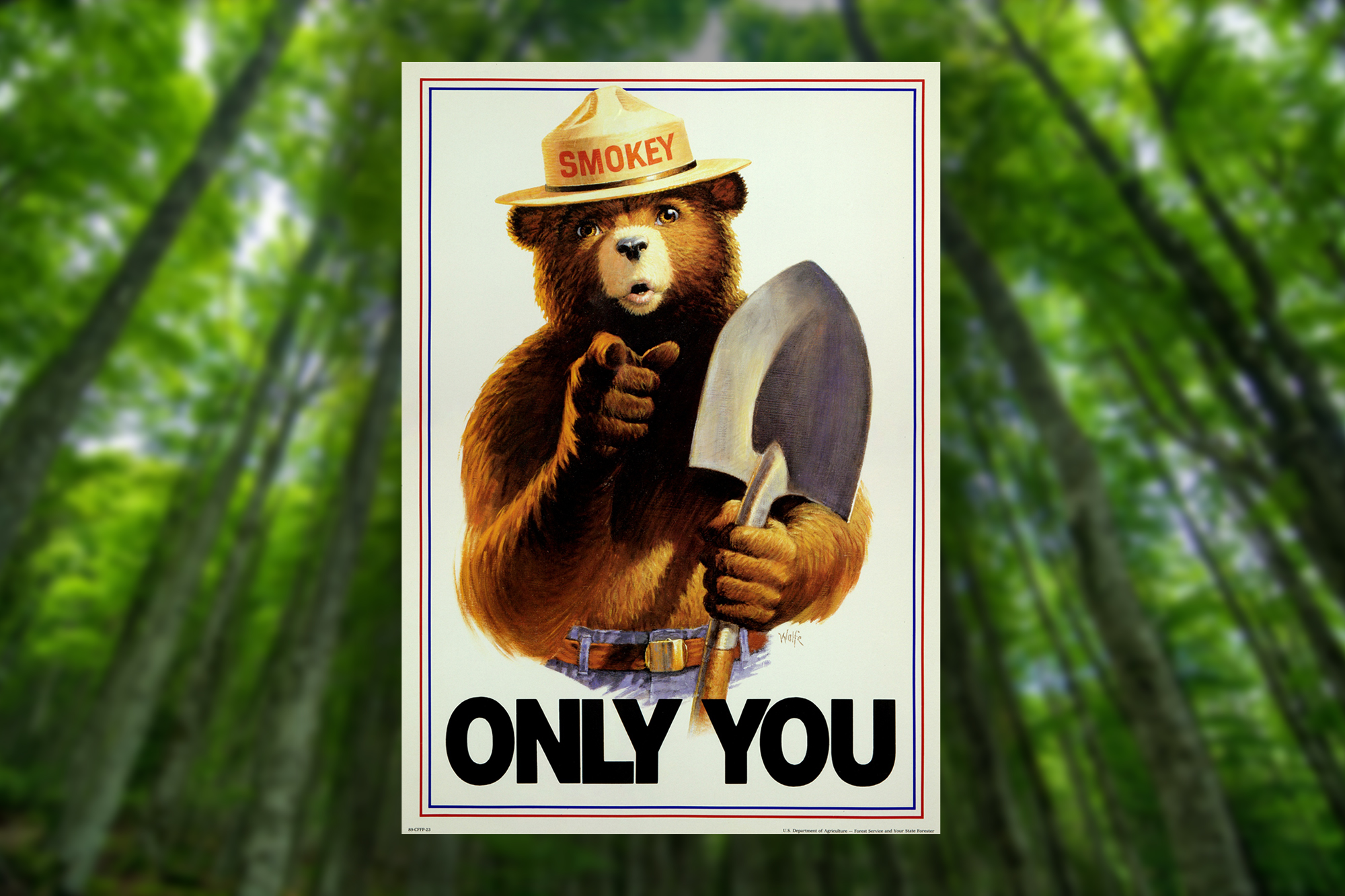
After World War II, the Forest Service's policy was prevention of fire and suppression of fire if one was to start. This policy gained popularity not just because of Smokey but was also due to an increasing Wildland-Urban interface where fires meant threats to life and property.
Forests were seen as pristine, and fires were seen as a direct threat to wilderness. But as mentioned before, wilderness is anything but pristine. It revolves around cycles of destruction and regrowth. Just as logging or developing impacts a forest—removing fire significantly altered these landscapes. The forests of today compared to those of the 1800s have tree densities 6 to 7 times greater. With more trees competing for sunlight and water, it leaves them vulnerable to additional stressors such as bark beetles, climate change and of course wildfire. When these vulnerabilities end in mortality, once vibrant forests turn into one giant tinderbox.
In 2018, scientists warned of disaster in Central California's Sierra National Forests after bark beetles killed off 150 million trees. The article claimed that conditions were prime for a megafire of catastrophic scale. Two years later, the historic Creek Fire burned nearly 380,000 acres to the ground.
Derek Mallia, a professor of atmospheric science at the U, studies pyrocumulonimbus (pyroCb) clouds—thunderstorms caused by intense smoke plumes from wildfires. These storms often produce dry lightning and high winds, which can ignite new fires and spread existing fires rapidly. Forming a pyroCb requires an atmosphere with moisture and instability at the mid-levels, allowing smoke to gain enough buoyancy to build into the cloud, along with a sufficiently intense wildfire. "In some cases, a wildfire can generate enough energy to create a pyroCb with less ideal atmospheric conditions, such as the Creek Fire, where the atmosphere was dry throughout the entire column," Mallia said. "It just wasn't conducive for that tall of a plume.
Mallia is now working with the INSPYRE (INjected Smoke and PYRocumulonimbus Experiment) campaign to improve forecasting and modeling of these events. He says smoke plumes are getting taller, but that there isn't yet a large enough sample size to confirm whether pyroCbs themselves are becoming more frequent. "But presumably, if your wildfires are becoming more intense, you'd expect at some point that that should result in more pyroCbs," Mallia said. "I think making that inference wouldn't be a stretch of the imagination."
Going forward
Generally when looking to the future, there is a preconceived notion that a solution needs to be novel. But in fact, if we just look backwards in time we would find that maybe we should be fighting fire with fire. This is easier said than done. When IFS took place, there were less structures to complicate things. Additionally, landscapes had not yet been altered by climate change and fire suppression. There are effectively fewer days to conduct prescribed burns. In May of 2026, the Utah Division of Forestry, Fire and State Lands (FFSL) successfully conducted a 1,500 acre controlled burn near Bountiful, Utah. Prescribed fires are now being deployed all over the state and can mitigate wildfire risk by 72%.
The roots for fighting fire run deep, from colonialism to World War II. But with the ramifications of fire suppression taking their toll, it is time to re-evaluate how best to move forward. Do we want consistent, low intensity fire to clear out debris or will we remove fire from forests only to be inevitably cleared by an exceedingly destructive one?
If the events of the past several decades have taught us anything, it's that the fire will burn anyway.
By Nathan Murthy