Interfacing with local industries

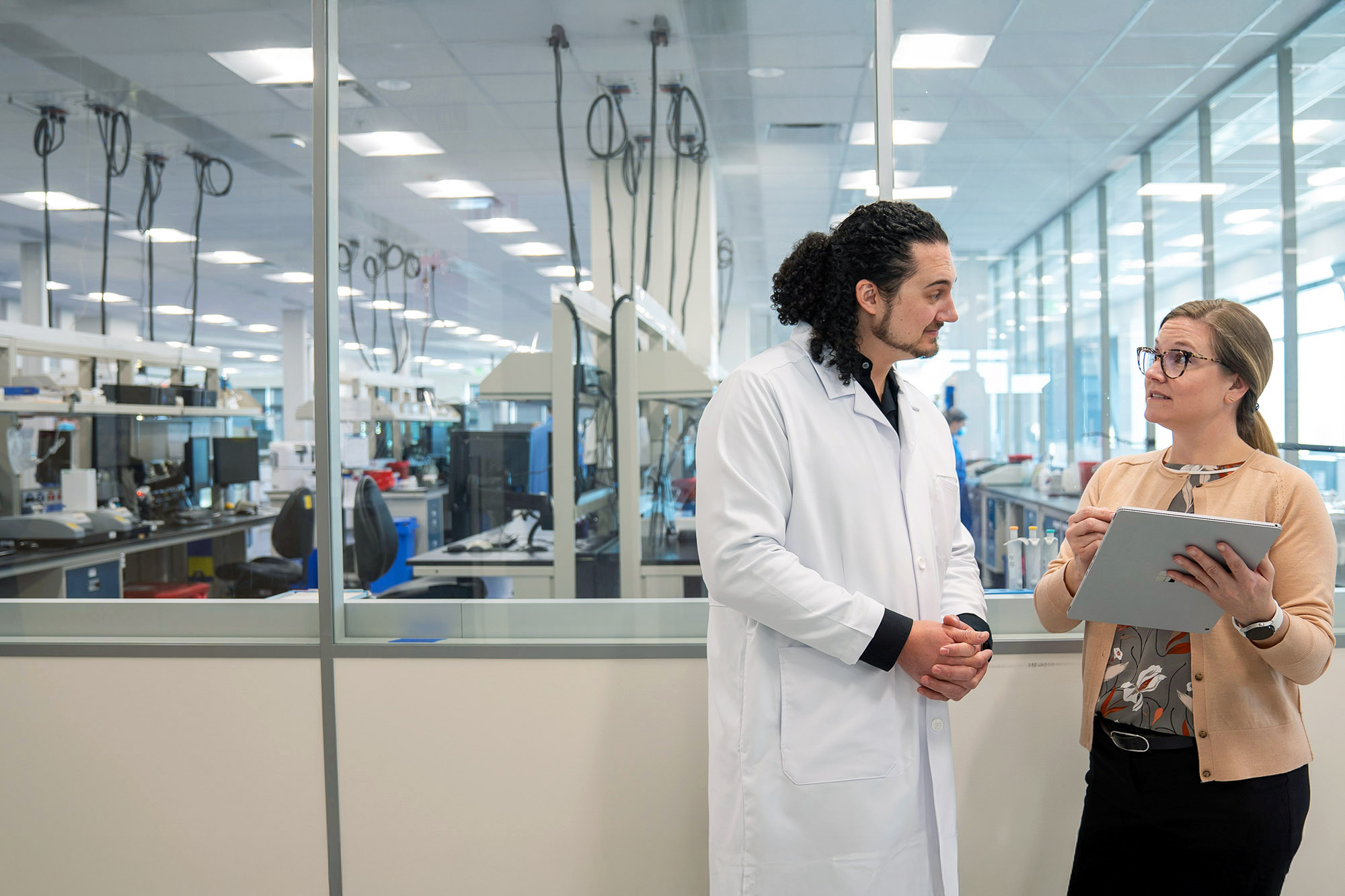
In addition to the workshops, a number of speakers from local industry, including, for example, biomerieux and ARUP, presented their company history and aims with an emphasis on how to identify, prepare for, and apply to internships and permanent positions within their organizations. Fall 2025 was dedicated to assessing and assisting students who needed research experiences with a focus on seeking and applying for internships as well as graduate study in the sciences and medical fields.
Stolley explains that in 2026, the CAP program will scale by increasing its enrollment and focusing on the same priorities: to increase readiness for post-graduate career opportunities and ensure students have the necessary skills to achieve their goals. “With a series of workshops throughout the semester,” says Stolley, “enrollment is free and voluntary and aims to meet the individual needs of students preparing for graduation.”
Caden Collins BS’24, now a laboratory technologist at Slopes Bio Inc., was not formally a part of the new SRI-CAP, but his journey through the U helped identify the need for this sort of initiative. Today, the first full-year cohort of SRI-CAP students are getting ready to graduate this spring, while other students in the program continue to benefit from trailblazers like Collins.
Accelerating your career

"The SRI-CAP program was an extremely valuable experience in my undergraduate journey,” says Will Pearce. Derek Mansfield '25, who worked for several years with Stolley, agrees: “I feel more capable of succeeding in my academic and professional career due to having participated in the program. It made me realize that I belong and am capable of succeeding in STEM."
Chelsea Bordon ’25 opted to continue working after graduation with Josh Steffen, director of SRI, as she applies to graduate school. “I started CAP at quite possibly the best time for me,” she says. “I was at the point of transitioning from being an undergrad to joining the workforce. That involved getting my CV ready and networking with people for jobs. Going through CAP really helped me accomplish both of those things.”
As a CAP student Bordon was provided with multiple resources, including career coaches and Handshake, a leading online career platform connecting college students and recent graduates with employers for jobs, internships, and career events.
Access is everything
“Having been out of the workforce for a bit, many of the techniques I had learned previously were outdated, or there were better options,” continues Bordon. “I think the biggest realization that I had taking the CAP program was the number of skills that I actually had. Experiences that I generalized on my CV and my personal statement provided many more skills than I initially thought.”

In 2026, the CAP program will increase enrollment while focusing on the same priorities: to increase access to post-graduate opportunities and build skills to achieve the students' goals. The CAP program works closely with U Career Success and the embedded career coaches within the College of Science to provide additional one-on-one support for students.
Concludes Bordon: “Getting into scientific research can be daunting, and available opportunities may not be obvious to people. The SRI not only provided that opportunity to get into research but also gave me valuable mentorship for future research jobs and graduate school. It helped me to believe that being a scientist is possible for me and opened a path that I didn’t think was there before.”
Both these programs, she concedes, “work extremely well together by providing resources for getting into the workforce and graduate school via CAP, or by directly providing research experiences through the SRI to be able to get into the workforce and graduate school.
“As the Science Research Initiative and SRI Career Accelerator Program continue to grow,” says College of Science’s Interim Dean Pearl Sandick, “we are working to ensure that these incredibly impactful student programs grow sustainably, and that as many students as possible can benefit from them. These opportunities are truly transformative and represent something unique that we are able to offer our students at the U.”
by David Pace
To learn more about the SRI-CAP program and enroll, click here.
Are you a STEM industry, company or start-up looking for interns and employees? A medical school or academic program looking for graduate students? We want to hear from you. Contact Ryan Stolley at ryan.stolley@utah.edu