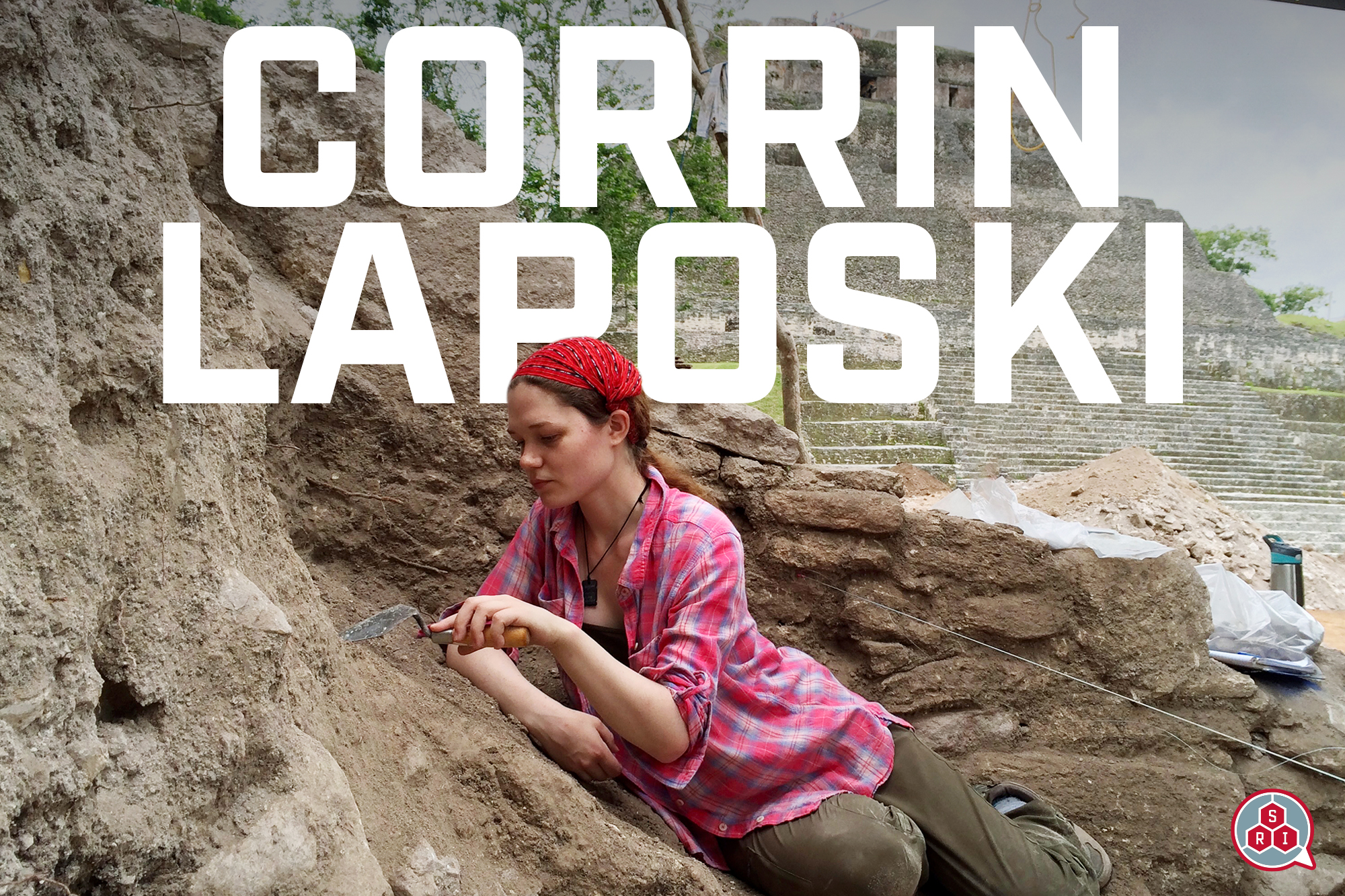
 It changed her life. Corrin appreciated the human aspect to anthropology where we weren't viewed as an externality but rather an integral variable of our earth systems. Corrin mentions, "There's this human aspect of our past, present and future which I grew fascinated with."
She transferred from Montana State to the University of Minnesota where she used mass spectrometry to analyze pottery shards and track historic Mesoamerican cacao trade routes. Although the research ended up being inconclusive, the experience she gained during this time was invaluable. Before arriving at the University of Utah as a Science Research Initiative (SRI) Fellow, she earned a Ph.D. in anthropology from the University of Connecticut.
Climate change and our food systems
The root of human-caused climate change is carbon emissions. Corrin's work as an SRI Fellow focuses on how these emissions can affect plant growth. As atmospheric CO₂ increases, you might think that plants, which intake CO₂ would benefit. In fact, studies at the Harvard experimental forest have shown that while tree growth can increase in correlation with a rise in atmospheric CO₂ and longer growing seasons, not all growth is created equal. "You have a lot of biomass but not a lot of nutrition in that biomass," she explains.
Corrin studies the effects of rising CO₂ emissions on plant nutrient density—specifically in C3 plants. She has found that although plant matter may increase, nutrient density drops. In other words, nutritional value is diluted. In the lab, Corrin and her students grow grass in chambers with varying carbon content. Then, once mature, she feeds it into an artificial rumen, part of the digestive system in ruminants (which includes cattle). This artificial fermentation system allows researchers to determine how organisms like grazers may be affected by the drop in nutrients and minerals such as nitrogen, phosphorus, zinc and iron which are all vital to living organisms.
For agriculture, this is a matter of concern. Grazing animals would have to consume more feed in order to meet their nutritional needs—expending precious energy. Areas which are water limited, like the American West, may have increased water demand for feed which could spell disaster for a system which is already heavily strained. Humans are not exempt from this issue. Our own food sources could become increasingly nutritionally dilute.
Woodsmoke and health
Another project on Corrin's mind is how woodsmoke from fires affects the health of both humans and wild animals. Research shows that humans might have begun using fire 400,000 years ago, but in that time we have not developed a substantial physiological protection from it.
"Smoke has been a very big part of our evolutionary trajectory,” she says. “Modern humans only have a very small degree of protection against wood smoke. Neanderthals and Denisovans, [distinct but closely related archaic human species], had even less."
An increase in organic plant material and longer growing seasons comes with a catch: longer fire seasons. According to the USDA, the fire season has extended from five to seven months since the 1970s and 80s. And the average burn time of a fire has increased from 6 to 52 days. All of this means that we are exposed to more woodsmoke. Over the last decade, the number of people that experience a hazardous smoke day has increased 27-fold.
While awaiting approval, Corrin has a clear plan for this project. First, she would expose rodents to low concentrations of woodsmoke and analyze their bone isotopes. This process shows how the immune system responds to smoke by leaving a lasting biological signature. Using this signature, we can compare it to organisms from the past.
This study reveals health impacts of increased exposure to woodsmoke. "It affects bone growth, fertility and even mental health."
Motivated by action
When asked about her work on the effects of climate change and what we can do about it, Corrin says that "Passive action will not help. This is an active threat." So, for students who are motivated by action, Corrin's lab is full of it. This lab is learning that climate change and wildfires harm humans and nature simultaneously.