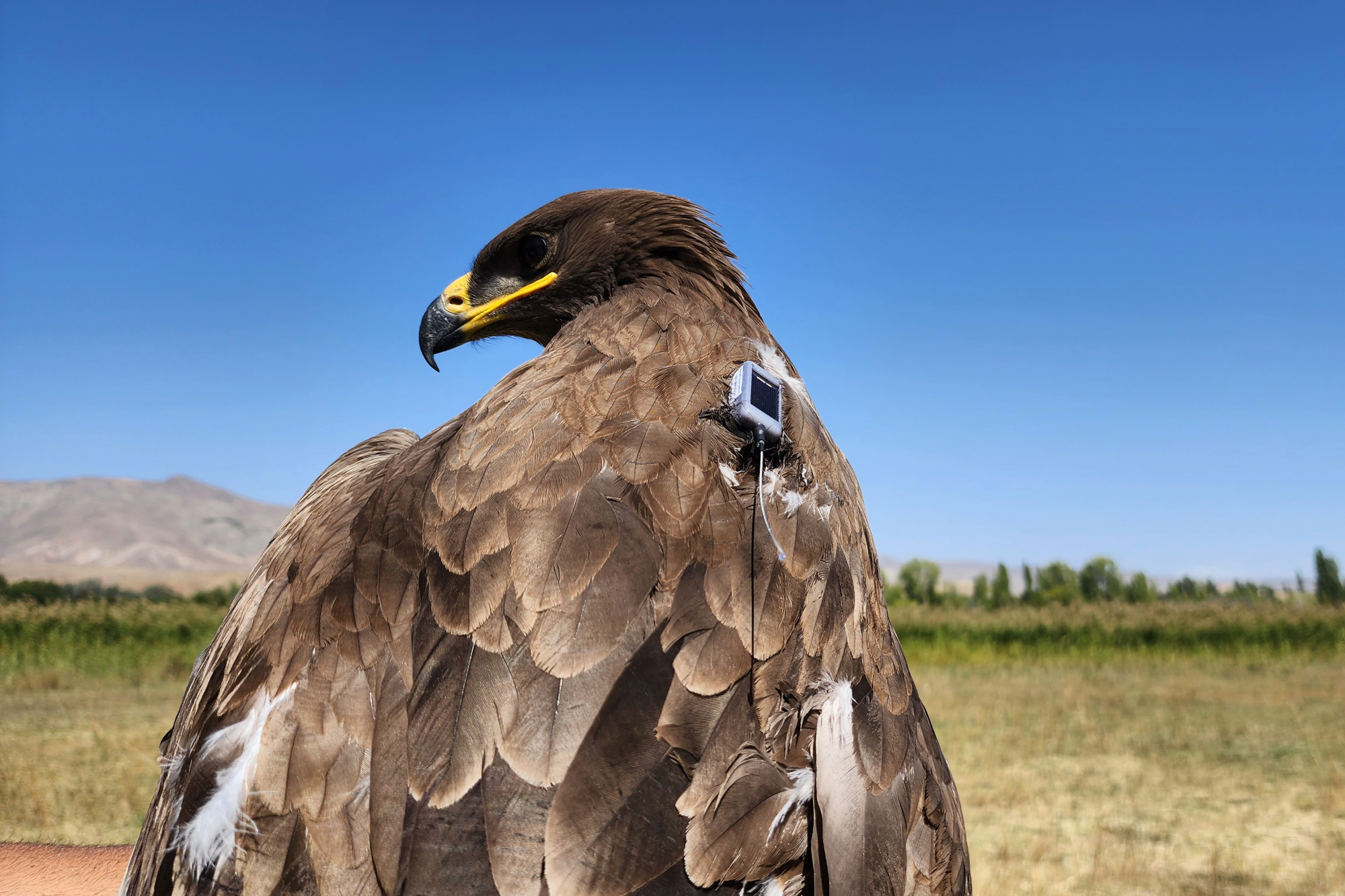

In 1899, scientists began tracking avian migration by placing a small ring with an identifier around birds' ankles. Researchers then had to recapture the birds elsewhere, leaving the journey between those points a mystery. Today, GPS tags allow researchers to see every stage of bird migration. The tags are small, have a long-lasting battery, a solar panel and track dozens of metrics. Migration is no longer described as just a theoretical range but rather an exact map. Despite this technological advancement, the routes of many species in their respective flyways remain undescribed.
Now, a new satellite tracking study by Nathan Murthy, a recent Earth and Environmental Science (EES) graduate from the University of Utah, describes the journey of migratory raptors along the understudied East Asia-East Africa Flyway. The Steppe Eagle, a highly endangered raptor species, has been tracked before in this flyway. As for the Booted Eagle, this is the first satellite tracking study in this flyway.
Publishing research as an undergrad
During his sophomore year, Murthy began volunteering for the Şekercioğlu Lab, also known as the Biodiversity and Conservation Ecology Lab at the U, run by Professor Çağan Şekercioğlu. After a year of data entry, he made a proposal to his mentor, Kyle Kittelberger, to develop a project of his own. Kittelberger pointed him toward satellite tracking data for a Booted Eagle and a Steppe Eagle from their bird banding station in Eastern Turkey. Murthy jumped at the opportunity. “The data was sitting around, and there were not enough people to do the work,” Murthy said. “If I hadn't asked for the opportunity, the data may never have been published.”
To support his work, Murthy applied for the Wilkes Scholars Program, which provides a $2,500 stipend per semester for undergraduate research. Kittelberger continued to advise Murthy during the analysis and writing process. In July of 2026, the paper titled "Where eagles dare: tracking data reveals migratory pathways of booted and steppe eagles in the East Asia-East Africa Flyway" was published in Zoology in the Middle East.
Spectacular and dangerous journeys
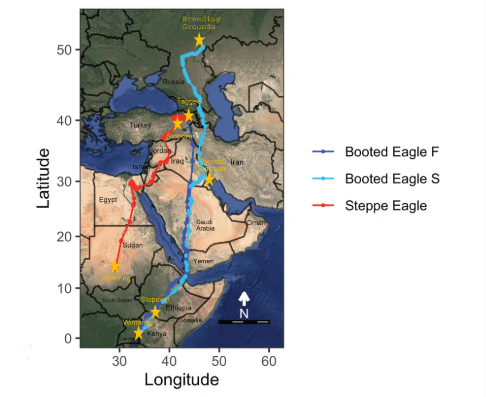
The East Asia-East Africa Flyway crosses more than 60 countries and stretches from northern breeding grounds in Siberia and Eastern Russia to wintering sites in eastern and southern Africa. Many of the more than 330 bird species along the corridor have to navigate major bottlenecks in the Middle East, including large bodies of water and growing anthropogenic stressors such as persecution, falconry, loss of habitat, increased pesticide use and collision with powerlines. Wildfires, advancing spring arrival times and extreme El Niño events also pose challenges in these areas.
“These journeys are spectacular and difficult—numbering in the thousands of kilometers,” Murthy said. “But… we just catch glimpses. A bird perched here, a bird soaring there—we get to join them for a brief second, but that's it.” He wanted to know more: what those glimpses actually mean.
Visualizing flight tracks with satellite data
Ultra-lightweight GPS-GSM transmitters were placed on a Steppe Eagle and a Booted Eagle at the Aras River Ornithological Station (ARORS) in northeastern Turkey. These specific raptors were captured, tagged, and released by Kayahan Ağırkaya, a Turkish researcher and ornithologist. When released, the eagles began their migrations right away.
The Booted Eagle migrated 5080.6 km in 49 days during the fall, crossing the Middle East and wintering on Mount Elgon in Uganda. It then largely retraced the route, traveling 6785.7 km in 35 days to breeding grounds in Russia. The Steppe Eagle, which was rescued by authorities in Turkey from a poaching operation, journeyed 4409.6 km over 38 days in the fall, diverging from the typical “loop” route via Bab al-Mandeb and instead crossing through the Suez Canal. However, the tag ceased transmitting at its wintering grounds in Sudan for unknown reasons—the tag could have fallen off, or the bird may have been killed.
Murthy analyzed the satellite data by first calculating the distance between each GPS location and the original banding point. This gave him a way to visualize the flight track and determine when the bird was in flight or stationary. To calculate the range boundaries of stopovers, non-breeding sites, and breeding grounds and better understand the types of landscapes these birds prefer, he used kernel UD (utilization distribution), a statistical probability map showing the likelihood that an animal will be found at any given point within an area.
What he found (more questions than answers)
“It's important to remember that in every lab on campus, when one question is answered, two more arise,” Murthy said of his results. “So there is always work to be done,” he advises other undergrads at the U. “Find it.”
As expected, these migrations painted a picture that opened up more questions than answers. The data could suggest that both the Steppe Eagle and Booted Eagle utilize human-dominated habitats for their breeding and non-breeding grounds. Throughout the journey, the birds stopped at trash dumps, agricultural areas and cities. Do human-dominated habitats play a functional role during eagle migrations? That might be a question for another researcher.
The study also illuminated regional bottlenecks in the Arabian Peninsula such as the Bab al-Mandeb strait, the Suez Canal and Eilat. Murthy found it concerning, however, that no land within these bottlenecks is explicitly protected, especially for endangered species like the Steppe Eagle. “It's important,” Murthy noted, “to do whatever we can to make our surroundings suitable for these birds when they pass through because every segment of their pathway is critical to their survival.”
Publishing a first-author research paper as an undergraduate is uncommon, but Murthy insists that it shouldn’t be. “I felt like I couldn't possibly publish academic research because of the difficulty and my lack of experience,” Murthy said. “But in researching migration, I learned that nothing is as hard as crossing thousands of kilometers of deserts and oceans. I am endlessly inspired by and curious about these marvelous creatures.”
The paper, published July 3, 2026, was co-authored by Kyle D. Kittelberger, Kayahan Ağırkaya and Çağan Hakkı Şekercioğlu, Professor of Biology at the School of Biological Sciences at the U.