
I set out to ask these athletes and scholars rock hard-hitting questions: What do you notice about the landscapes you run through? Why are people in your field such avid runners? How has running made you a better scientist?
Globally, there are roughly 621 million runners, and each has their own motivations. Here are three stories about running and rocks.
Katie Schide: from thesis to trails

Katie Schide is an alumna of the U and one of the top ultrarunners in the entire world, having won the most prestigious 100-mile races including the Ultra-Trail du Mont-Blanc—the world's premier trail running event held annually in Chamonix, France (UTMB)—Western States and Hardrock.
During her undergraduate years at Middlebury College in Vermont, she took a course called "Mountains of the Northeast." Though it was a writing class, the geology professor who taught it opened her eyes to the science behind the mountains she saw every day.
"I realized that this was a whole field of study I didn't know anything about,” she says. ”And yet, it was studying exactly what I like to think about."
Schide went on to complete a master's degree at the U where her thesis investigated the intermediate shorelines of Lake Bonneville. . As a runner she often trained on the Bonneville Shoreline Trail, traversing the very landscape she was researching.
She then pursued a doctoral degree at the Swiss Federal Institute of Technology (ETH) in Switzerland, with fieldwork that took her to Nepal. It was there she made an important realization: science is not to be romanticized. Neither was fieldwork, she learned, as research procedure became routine at the same site year after year. As her passion for research began to wane, her successes on the trails steadily accelerated.
"I really don't think I would have finished my Ph.D. if it wasn't for my supervisors being so supportive and patient."
Schide finished her doctorate in 2022 and shifted her focus entirely to running. The results were immediate. She's since won some of the top-ranked races, including the prestigious UTMB, and was named Trail Runner of the Year by “Ultra Running Magazine” in both 2024 and 2025. Though she has stepped away from academia, she carries its lessons with her wherever the trails lead. She is quick to add that "being in academia helped me with goal setting, time management and being self-directed."
John Bartley: training for the field
John Bartley has been teaching and researching Geology and Geophysics at the U since 1985. His career focused on structural geology—the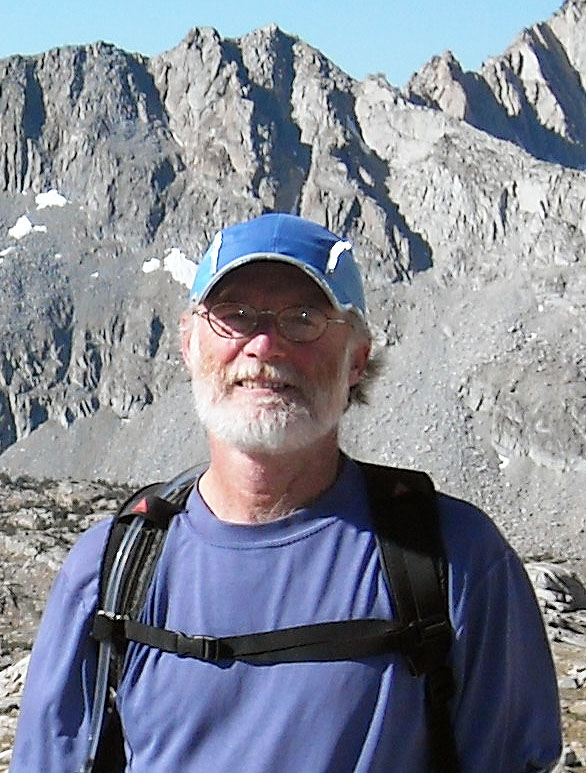 geometry, movements and forces that shape rocks. Alongside that distinguished career, he has completed a whopping 87 ultramarathons.
It started with rock climbing at 15. Growing up in Seattle, he climbed Mount Rainier and was hooked on the mountains ever since. That same love eventually drew him to geology which he studied at the University of Washington before heading to graduate school in Boston. That new setting lacked the mountains in which he recreated in as a child, so he started running simply to stay in shape for the demanding physical nature of fieldwork.
The real turning point came after Bartley joined the faculty at the U. A graduate student asked him to pace the final 27 miles of the Wasatch 100—a point to point race which covers a stunning stretch of the Wasatch Mountains. For most people, running 27 miles through the mountains in the dark sounds like a nightmare. For John, it was an overnight conversion to a new sport.
"Before that I was a road runner and after that, I was a trail runner who did very little training on roads," he says,
He dove in completely—logging four trail marathons, thirty-five 50Ks, ten 55Ks, sixteen 50-milers, six 100Ks, and one 100-miler over the years amongst other various distances including 24-hour races. The fitness translated directly to his science.
"The connection between science and ultrarunning for me is simply that it made more field things possible. Field projects were possible because of endurance from ultrarunning and my experience as a climber."
That fieldwork paid off in a big way. Over the last 25 years, Bartley helped overturn conventional thinking about how large granite bodies, like those found in Little Cottonwood Canyon, actually form. The initial assumption was that they arose from a single magma body. It turns out they grow incrementally over millions of years, a finding with real implications for geothermal energy systems and predicting volcanic activity.
Just as granite forms incrementally, so too have John's endurance and impact on his field. At 74, he still covers 50 miles per week. His story is one of persistence and grit, which is not unlike the geology he has spent a lifetime studying.
Lauren Birgenheier: connections with landscapes and people
 Lauren Birgenheier is a professor in the U's Geology and Geophysics department, specializing as a sedimentary geologist and geochemist. Her work reaches back through deep time, reconstructing ancient environments from the rocks left behind.
"We try to reconstruct what the ancient environment was like millions of years ago when those rocks were deposited," she explains.
Like Bartley and Schide, Birgenheier's path to geology originated from a love of the outdoors. She was always an athlete. In college she swam competitively, but running never really took hold until after she had a daughter.
"I started more seriously because it was kind of a thing I could fit in with a young kid and the demands of a job."
What began as necessity quickly became something more. Running gave her peace, clarity and a new way to connect with the landscapes, especially when geology field work became harder to fit in between parenting and teaching.When running in a place like Park City, she doesn't just monitor her footing; she also notices formations like Nugget Sandstone, a Late Triassic to Early Jurassic geologic formation that outcrops in the western U.S. and would be completely invisible to the untrained eye.
That steady accumulation of miles eventually carried her into ultramarathon territory. She raced a 50K in Park City and a 55K through Canyon de Chelly, a sacred site on the Navajo Nation normally closed to the public without a guide. Running through it during a race was, she said, a rare and meaningful privilege.
Birgenheier loves to run alone, but she also values running with others. She is drawn to the shared commitment to doing hard things. "I've learned that it's really hard to beat running with friends," she remarked. That said, she has no desire to run past 55K. That's her sweet spot. But for most of us, 55K is more than we could ever imagine.
More than a hobby
When I set out to interview these three geologists, I expected to find overlapping motivations and tidy parallels between their science and their sport. This is not exactly what I found. Each story was entirely its own. But what came through in all three was something deeper: for serious runners, running isn't really a hobby. It's more like brushing your teeth. It keeps you fit, keeps you sharp, and over time it takes you places you never knew were possible.
By Nathan Murthy