
They have long argued over why so much magma surfaced here in what was among the biggest volcanic events in Earth’s history, one that is implicated in a period of intense global warming during the Eocene Epoch. Was a deep, superhot mantle plume responsible, or did crustal thinning play the bigger role?
Now, University of Utah geoscientists are stepping forward with clues to help answer this question after examining basaltic cores extracted from the ocean floor off the Norwegian coast. The chemistry seen in these drilling cores suggests that thinning of the lithosphere, driven by plate tectonics, was the more important of the two factors.
“Both of them are involved for sure. It’s a chicken and egg situation,” said Sarah Lambart, an associate professor of Geology & Geophysics. “We now have evidence for significant extension before you have this peak of magmatism.”
Her findings, reported in the journal Geochemistry Geophysics Geosystems, or “G-Cubed,” are based on analyses of basalt cores Lambart and an international team pulled off the ocean floor while sailing on a 2021 expedition facilitated by the International Ocean Discovery Program. The program’s Expedition 396 targeted sites on the Vøring Plateau, a marine region in the Northeast Atlantic characterized by thick basalt deposits.
How basalts reveal the formation of oceans
These basalts are time capsules representing different rifting stages during the final breakup phase of the ancient supercontinent Pangea. By analyzing their chemistry and running advanced statistical melting models, this effort, led by U graduate student Emily Cunningham, reconstructed what the mantle source rocks were made of and how melting conditions changed over time.
“Her results reveal a clear shift of mineralogy coinciding with the peak of magmatism,” Lambart said. “Combined with other pieces of evidence, we showed that this shift of mineralogy is likely due to a remobilization of metasomatic veins in the lithosphere and underplated magmatic material beneath the crust.”
These findings matter to science because volcanic rifted margins, like the Vøring Plateau, exist around the
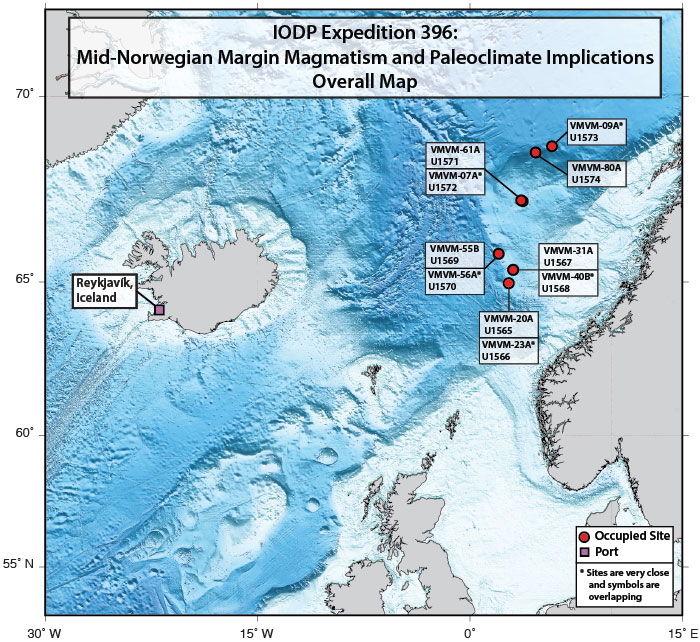
word. They were instrumental in the formation of ocean basins and their formation coincides with major climate events and mass extinctions in Earth’s history.
“Earth is one of the few planets that we know for sure has plate tectonics and we fundamentally don’t understand how that started,” Cunningham said. “There’s still big disagreement about how and why some rifts are successful and result in the formation of an ocean, while other fails. We don’t really understand the mantle conditions that explain why those rift margins are different. This has an interesting planetary science aspect on why we have plate tectonics here [on Earth] and how that started.”
A sudden change in mineralogy
Cunningham implemented what’s known as a Monte Carlo approach (yes, it’s a reference to games of chance) to estimate the source mineralogy of the basalts emplaced on the Vøring Plateau at the peak of the ancient magmatism. Her program modeled millions of randomly selected mineralogies based on five source minerals to estimate which recipe produced the basalts found in the cores.
Her analysis determined the source rock at peak magmatism was rich in a mineral called clinopyroxene, which proved to be the smoking gun pointing toward lithospheric thinning as the key driver.