Minecraft & the real world
An inaugural gen-ed class uses the video game to teach mining literacy
Not every general education course asks you to play a video game as the primary platform for learning, but that is exactly what you’ll find right now in MG EN 1000 taught by Aaron Young, research assistant professor in the Department of Mining Engineering at the University of Utah.
If you’ve spent any time playing Minecraft (or watching someone play, which is now common), you know that structurally it is about extraction—mining things to craft with and crafting things to mine with. You also might know that it’s wildly popular. In the U.S. there are more than 45 million monthly active Minecrafters; that’s a lot of virtual miners compared to the nation’s <580,000 actual mining workers. Now fifteen years old, “Minecraft is one of these ubiquitous games that most kids interact with on a fairly regular basis,” said Mining Engineering Department Chair Pratt Rogers. “[And] it's deeply connected to the name ‘mining’—sourcing minerals and using those in civilization."
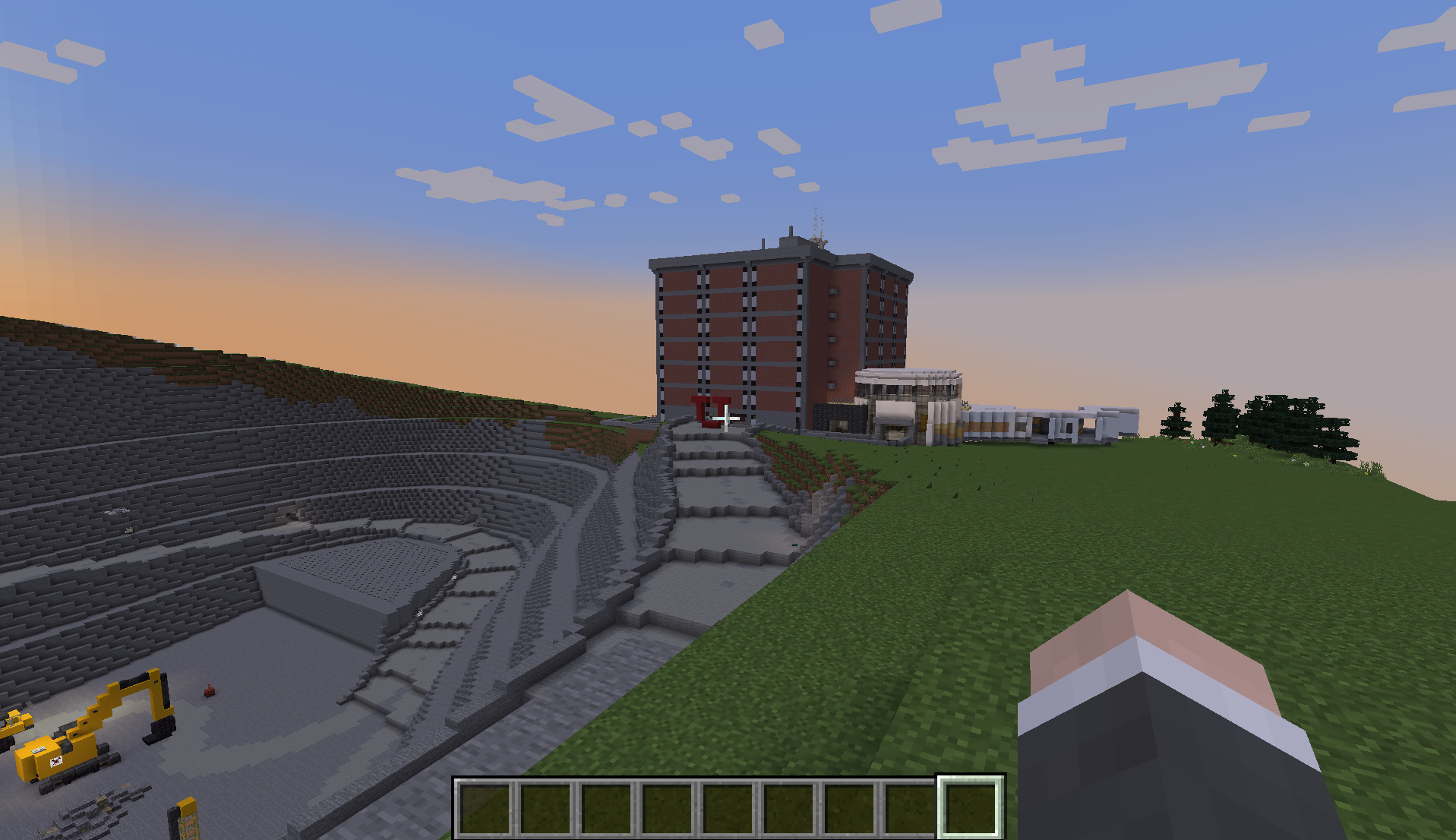
The 65 individuals enrolled this semester in Minecraft & the Real World: Mining, Materials and Modern Society include first-year students through seniors, studying everything from mining to fine arts and nursing. Each student in the class, using Minecraft Java Edition, is assigned a building on campus, and together they are constructing the University of Utah from the ground up, along with a virtual mine to obtain the commodities that would have supplied it. That virtual campus design task requires students to determine how many resources go into different building components, like the cubic yards of cement used in a building's foundation, the tons of steel I-beams needed to support the building's structure and the energy needed to heat the building.
While the project is virtual, students will be limited by real-world constraints—land-use designations, permitting requirements, waste management, trade-offs and, maybe most importantly, civic discourse.
Why Minecraft, why now?
The objective of the class, according to the syllabus, is to “explore how physical science principles govern modern resource extraction and materials flow.” During the semester, students use Minecraft as a collaborative space and “sandbox laboratory” to unearth “not only how mining really works, but also how it affects their daily life, from ore bodies to everyday devices.” Young and Rogers remind students that materials for phones, homes, semiconductors, solar panels and cars have to be extracted from the Earth as ore, refined and sent to manufacturing facilities before they’re fashioned into marketable products—a hard-to-fathom concept that Minecraft is well-suited to illustrate.
And it comes at a time of renewed focus on mining in the U.S.
As demands for critical minerals (CM) increase, the federal government is expanding its investment in domestic mining to ensure national security and economic resilience while reducing dependence on foreign sources. Utah hopes to fill 20% to 25% of the country’s CM demand, Dean Pearl Sandick is elevating work out of the College of Mines & Earth Sciences (CMES)—part of the College of Science—to address the needs of the CM pipeline by preparing the next generation of mining engineers and students interested in mineral development.
An unsuspecting part of that next generation? Minecrafters.
Training in trade-offs
Mining students routinely seek practical solutions to seemingly intractable questions surrounding CMs. Instead of asking if we have to choose a comfortable lifestyle, our national security or an indefinitely growing economy over the preservation of the environment, they seek real-world mining solutions that meet our national, economic and personal needs. In short, they become experts at trade-offs.
"We don't do very well in society communicating trade-offs of any sort of development,” Rogers said. “Be it data centers, be it mines, be it … everything. It [instantly] becomes hyper-political. … It’s only trade-offs.” The hope is that Minecraft & the Real World at the U can provide a robust framework for hashing out those trade-offs in a group setting.
For example, one of the inaugural class’s key objectives is practicing civic discourse. Through discussing international mining case studies and collaboratively building a sustainable world in Minecraft, students will, according to the syllabus, “compare worldviews, and examine how social, economic, and environmental systems interconnect and influence their lives.”
Already, U Facilities has provided blueprints of forty different buildings on the U campus (with sensitive areas withheld), and students have started the process of figuring out how to reconstruct them virtually. They’re designing and testing mining systems, analyzing energy/throughput/pollution trade-offs and evaluating scientific claims and sources. “The idea,” said Young, “will be to show the mass balance on how many blocks of waste you need to get [the amount of] copper [that] goes into your university."
Of course, the mine being constructed virtually must be modeled on real operations, with real land use and real waste volumes considered. More trade-offs. "For every pound of copper,” explained Rogers, “you have upwards of 800-1,000 pounds of waste rock. … If you look at the map of Salt Lake, the tailings impoundment [of nearby Kennecott Copper] is two or three times bigger than the airport." Building virtually but fully anchored to the realities of ethical mining, students will propose mitigation and reclamation strategies as part of the project.
First of its kind
To the best of Young’s knowledge, this is the first time Minecraft has been used in the classroom to solve mining, workforce and public literacy problems. It’s also the first time the U has offered a general education course where the syllabus asks students to virtually dig an open-pit copper mine next to the Student Union Building. “Not that anybody wants a big open-pit copper mine next to their university, but it might be very educational for people to go, 'Oh, that's where my phone comes from.'”
Overall, Minecraft & the Real World is showing real promise; the most telling endorsement, perhaps, is when Young said, "I've had a student tell me they're talking to their parents about it at dinner every night." Already there’s talk about an AP/concurrent-enrollment high school version, a possible guest lecture from Minecraft movie writer Hubbel Palmer (coincidentally, a U professor in the Film Department), a visit to the National Institute for Occupational Safety and Health VR mining classroom and an end-of-semester video walkthrough of the finished world.
Assuming the class continues for many semesters to come, Young intends to keep the server in place, with each cohort leaving its mark by adding to the world. He expects the current class to finish the entire U campus, so future classes will be tackling similar but unique mining trade-off problems within the same server.
One can imagine virtual placards within the world where each successive class has broken ground literally … and virtually: “From the Class of [fill in the year].”
But there’s nothing more groundbreaking than being the inaugural class, said Young. "I think a lot of people in the future are going to be jealous of the class of 2026."
By David Pace and Ben Kilbourne
September 24, 2026